IFS Loops Digital Workers: Closing the Execution Gap in Industrial Operations
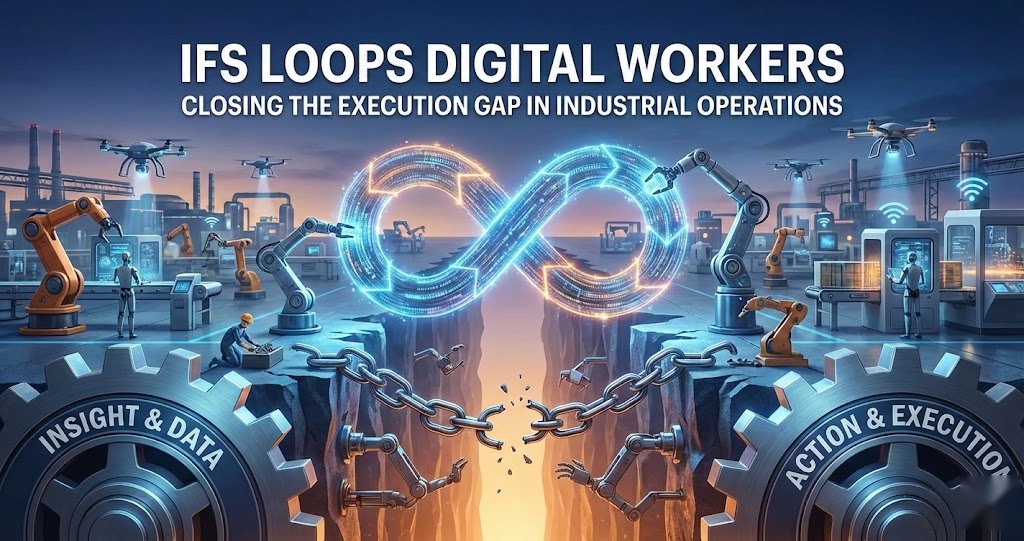
IFS has entered a new phase of operational automation—and the commercial implications for industrial organizations are worth paying attention to.
Here’s the thing most operations teams already know but rarely say out loud: the problem isn’t insight. You have the data. Your people are making the right calls. The friction sits in what happens after the decision gets made.
Orders need validation. Exceptions pile up. Inventory levels drift. And too often, all of that lands on someone manually toggling between systems, refreshing inboxes, and chasing the next step. It’s not glamorous work—but it’s the work that determines whether anything actually gets done.
We call this the execution gap. Not a failure of intelligence. A failure of capacity to carry decisions through to completion, reliably, at scale.
IFS Loops is IFS’s answer to that gap: an agentic platform for industrial process automation that delivers purpose-built Digital Workers designed to close it from the inside out.
1. A New Execution Layer Within IFS Cloud
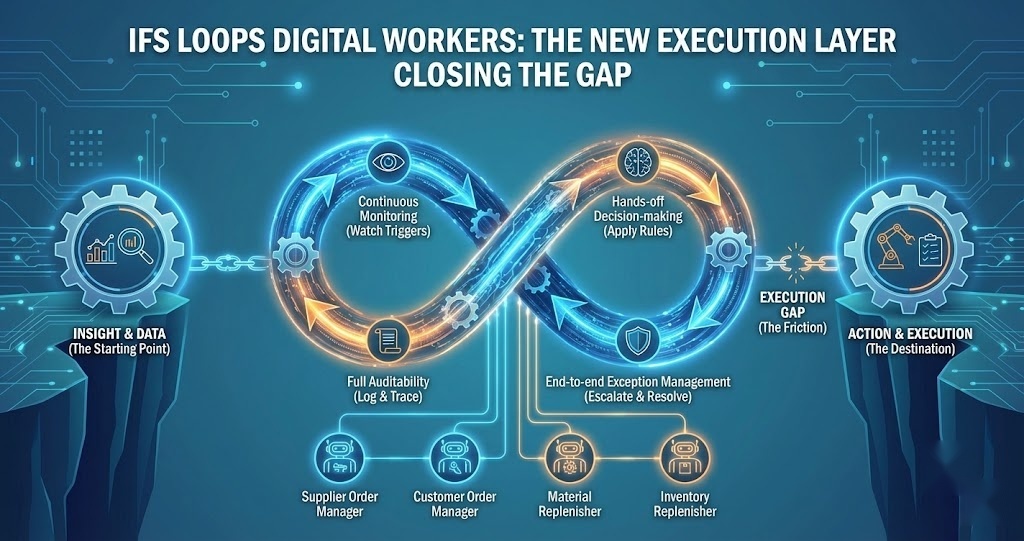
Digital Workers aren’t just task automators. They take ownership of entire workflows—watching for triggers, applying business rules, making the routine calls, and handling exceptions end-to-end. Humans only get pulled in when actual judgment is needed.
What that looks like in practice:
- Continuous monitoring of operational conditions and triggers
- Hands-off decision-making within defined business rules and thresholds
- End-to-end exception management that escalates only when it should
- Full auditability—every action logged, every decision traceable
The bottom line? Insight actually turns into action. Processes keep moving. And execution becomes a governed, scalable capability—not a bottleneck that depends on who happens to be available.
2. Digital Workers in Action — Available from 25R2
IFS Cloud 25R2 introduces four Digital Workers, each built around a specific high-volume, high-friction role. Here’s what they do and who they help.
Supplier Order Manager
Best for: Procurement and supply chain teams
If your procurement team spends half their day checking order status and chasing supplier responses, this is for them. The Supplier Order Manager takes ownership of supplier-facing execution—automating communications, validating purchase orders, and managing exceptions when things change. It flags issues only when someone actually needs to step in.
What changes:
- Fewer delays and fewer errors in the procurement cycle
- Significantly less time burned on routine supplier coordination
- Procurement teams freed up for strategic sourcing instead of admin follow-up
Customer Order Manager
Best for: Order processing and customer service teams
The Customer Order Manager handles the front end of order execution—automating order and PO creation, validating data across systems, and catching errors before they cascade downstream. In high-volume environments where speed and accuracy directly affect customer experience, this one pays for itself fast.
What changes:
- Manual validation and rework drop dramatically
- Errors get caught at the point of entry, not after they reach the customer
- Your team focuses on exceptions and relationships, not data cleanup
Material Replenisher
Best for: Inventory managers and planners
This Digital Worker continuously monitors part requirements and inventory levels across sites. When a need surfaces, it checks availability, evaluates fulfillment options, and recommends the best path forward. No waiting for someone to notice the gap.
What changes:
- Higher first-time fix rates through proactive material availability
- Fewer stockouts disrupting operations
- Replenishment runs in the background—hands-off, always on
Inventory Replenisher
Best for: Distribution and warehousing teams
The Inventory Replenisher focuses on ongoing inventory health. It forecasts demand, watches inventory positions, and triggers replenishment automatically based on your defined rules and thresholds. Planners stop babysitting stock levels and start focusing on the work that actually needs their brain.
What changes:
- Consistent inventory coverage without someone manually watching dashboards
- Demand-driven replenishment aligned to your KPIs
- Less time spent on decisions that should be automatic
3. The Commercial Impact
Across all four use cases, the impact shows up in ways you can actually measure:
- Capacity recovery — Your team gets hours back every day. Hours that used to disappear into manual checks, follow-ups, and data capture.
- Execution consistency — Workflows run the same way every time. Doesn’t matter who’s on shift or which region is involved.
- Earlier error detection — Problems get caught before they turn into service failures or cost blowouts downstream.
- Governance and transparency — Every action logged, every decision rule-based. IT gets the structure they need. Business gets execution that actually moves.
And here’s what makes it especially compelling: this is operational capacity that scales without hiring, without outsourcing, and without re-architecting your core systems. The ROI starts the moment a Digital Worker takes over a workflow that used to be manual.
4. Closing the Execution Gap
IFS Loops Digital Workers reflect a belief we share with IFS: insight only matters if it leads to action.
With 25R2, organizations get a clear path from knowing what should happen to making sure it actually does. Digital Workers own the execution, remove the operational drag, and give your people back the space to do the work that requires their experience and judgment.
The starting point is deliberately simple:
- Identify one workflow that eats up disproportionate time and attention every day
- Hand it to a Digital Worker
- Measure the impact on cost, speed, and accuracy
- Expand from there
When execution stops being the bottleneck, everything else moves faster.
Want to explore how IFS Loops Digital Workers could drive real value in your operations? Let’s talk through the commercial implications for your organization—reach out to your JumpModel representative and we’ll build a phased roadmap together.