IFS Just Told Us Where Industrial AI Is Actually Going. The H1 2026 Numbers Back It Up.
Every software vendor says AI is transforming their business. Very few can show you the invoice. With its H1 2026 results, IFS did exactly that, and we believe this marks a turning point in how industrial enterprises should read the market.
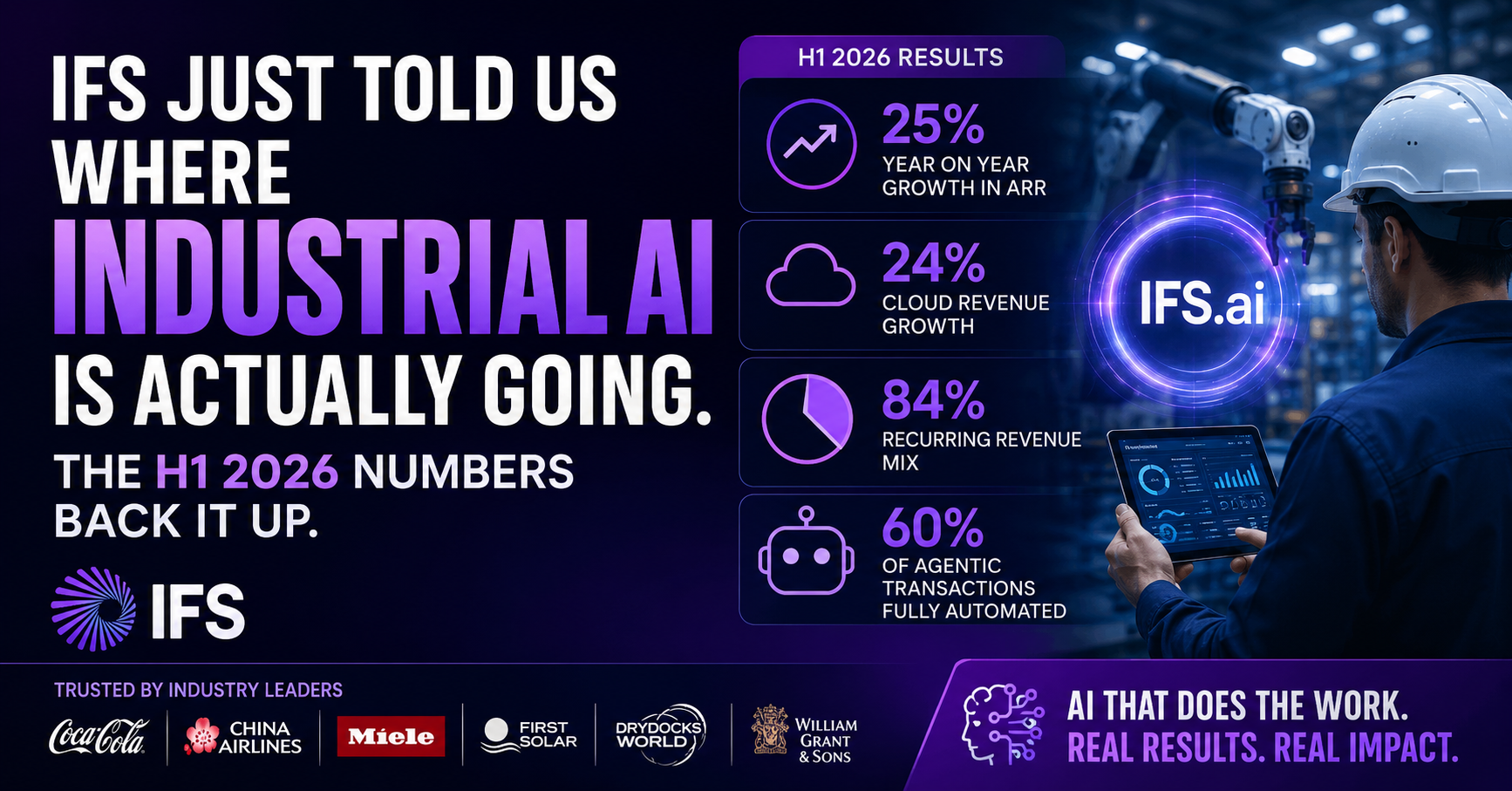
The headline numbers are strong: 25% year on year growth in annual recurring revenue, 24% growth in cloud revenue, and a recurring revenue mix that now sits at 84% of the total. But the numbers are honestly the least interesting part. What matters is what sits underneath them: a platform strategy that has quietly moved from talking about AI to executing work with it.
Here is what we took away, and what it means for your organization.
1. The Revenue Mix Tells You the Model Has Flipped
An 84% recurring revenue mix is not a vanity metric. It tells you that the overwhelming majority of IFS customers have committed to the cloud, subscription based model, which is precisely where IFS.ai capabilities live and ship.
Why should you care? Because in enterprise software, the money follows the roadmap. When 84% of revenue renews on subscription, the vendor’s commercial incentive is retention through continuous innovation, not the next big license deal. For customers, that alignment is worth more than any single feature.
CEO Mark Moffat called this period “the market inflection point we’re now seeing.” That is a bold claim. The customer list, which we will get to, suggests he has earned the right to make it.
2. Digital Workers Are Doing the Work, Not Just Suggesting It
This is the finding we would put on a slide for your board.
The IFS Loops Agentic Platform now runs Digital Workers with 60% of agentic transactions fully automated. Read that again. Not “AI assisted.” Not “flagged for human review.” Fully automated, end to end.
For years, enterprise AI meant decision support: a dashboard, a recommendation, a nudge. The human still did the work. What IFS is reporting is contextual execution, where the system carries out the transaction itself. The commercial implications extend well beyond productivity dashboards:
- Labor hours shift from processing transactions to handling exceptions
- Cycle times compress because work no longer waits for a person to be free
- Error rates fall, since automated execution does not get tired on a Friday afternoon
Organizations that adopt this approach will find the ROI conversation changes shape. You are no longer justifying a tool. You are costing out a worker.
3. The Product Line Is Aimed at Problems With a Price Tag
The H1 innovations share one trait: each one attacks a cost line you can already find in your P&L.
- IFS Nexus Black’s Resolve predicts field service faults before they take equipment down. Downtime is the single most expensive line item in asset heavy operations, and Resolve exists to shrink it.
- IFS Zero cuts the effort of emissions data collection by up to 30%. If your sustainability team is drowning in spreadsheets ahead of every reporting cycle (and most are), that is a very tangible relief.
- The Softeon acquisition brings warehouse management and robotics orchestration into the portfolio, extending IFS execution capability from the field into the four walls of the warehouse.
Notice the pattern. None of these are AI for the sake of AI. Each capability is anchored to downtime, compliance effort, or fulfillment cost. That is how you evaluate industrial AI: not by the demo, but by the line item it deletes.
4. The Customer Wins Are the Real Proof
Vendors can spin numbers. They cannot spin logos. In H1 2026, IFS signed Coca-Cola, China Airlines, Miele, First Solar, Drydocks World, and William Grant & Sons.
Look at the spread: consumer beverages, aviation, home appliances, solar manufacturing, ship repair, and premium spirits. These are asset heavy, operationally complex businesses with very different value chains, and they all reached the same conclusion in the same six months. When buyers this sophisticated and this diverse converge on one platform, that is the market inflection Moffat is describing, showing up in signed contracts.
The industry seems to agree. IFS.ai took ERP Today’s AI and Innovation of the Year award, and IDC MarketScape named IFS a Leader for AI enabled enterprise asset management in asset heavy manufacturing. IFS is also now featured at Microsoft Experience Centers in Munich, Silicon Valley, and Singapore, which tells you something about who wants to stand next to this story.
5. The Ecosystem Play: Engineering to Enterprise, Connected
Two quieter developments deserve your attention.
First, leadership: Ryan Courson stepped in as CFO, taking over from Matthias Heiden between the Q1 and H1 results. A new CFO arriving amid 25% ARR growth usually signals ambition for the next phase, not a correction of the last one.
Second, partnerships: IFS expanded collaborations with Siemens, AVEVA, and NEC, linking engineering data, operational technology, and enterprise intelligence into one connected thread. For industrial operators, this is the unglamorous plumbing that determines whether AI actually works. Digital Workers are only as good as the data they execute against, and these partnerships are how that data arrives clean and in context.
What This Means for You
Here is the shift, side by side:
| The old conversation | The H1 2026 conversation |
|---|---|
| AI as decision support | AI as work execution, 60% fully automated |
| Pilot projects and proofs of concept | Coca-Cola and China Airlines in production |
| Sustainability as a reporting burden | Emissions data effort cut by up to 30% |
| Best of breed point solutions | One platform from field service to warehouse |
The execution test IFS now faces is real: converting this momentum into sustained delivery at scale. But the direction of travel is unambiguous. Industrial AI has left the lab, and the vendors who can prove it with revenue, logos, and automated transactions are pulling away from the ones still selling roadmaps.
If your organization runs complex assets, dispersed field operations, or demanding fulfillment networks, the practical question is no longer whether agentic AI applies to you. It is which of your cost lines it should attack first.
Let’s grab a coffee and work through that question against your own numbers. We would be glad to help you map where Digital Workers could take the first shift.