Commercial Implications of IFS.ai: How to Drive Real Value in Your ERP Strategy

In the world of industrial operations and asset management, the buzz around Artificial Intelligence (AI) has reached a fever pitch. But for many IFS customers, the conversation often feels detached from the bottom line. You might hear about “predictive intelligence” or “autonomous agents,” but as a business leader, your primary question remains: How does this actually impact my margins, and what does it cost?
At JumpModel, we see a recurring pattern: most IFS customers utilize only 30–40% of the system they are already paying for. With the introduction of IFS.ai, the stakes have become higher. AI isn’t just an “add-on” anymore; it’s a metered engine that requires a strategic roadmap to ensure the return on investment (ROI) outweighs the operational cost.
Here is how you should think about the commercial implications of IFS.ai and the steps you can take to drive real value.
1. Understanding the “Token” Economy
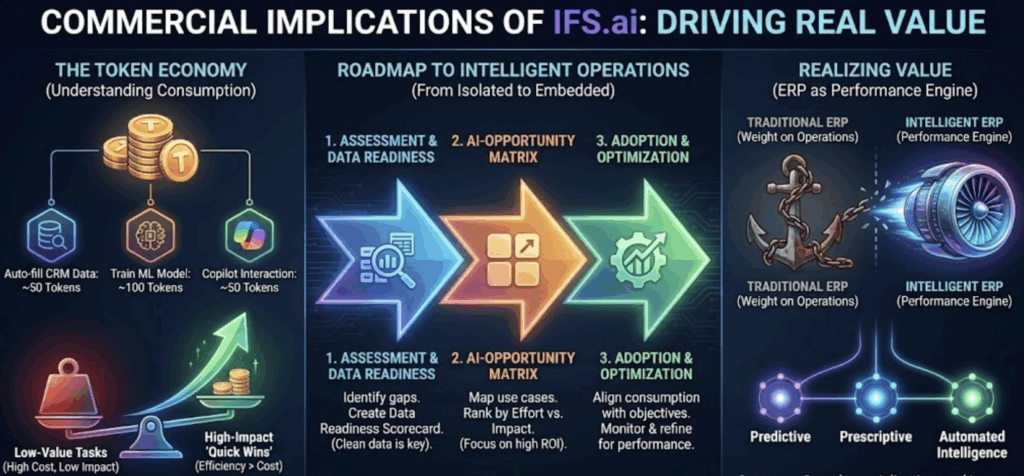
One of the most significant commercial shifts with IFS.ai is the transition to a consumption-based model. AI capabilities in IFS Cloud—from the IFS.ai Copilot to Business Opportunity Prediction—operate on a token system.
This means that every AI-driven action has a literal price tag. For example:
- Customer Contact Automation: Scanning a business card or email signature to auto-fill CRM data costs roughly 50 tokens.
- Predictive Modeling: Training a Machine Learning model for Business Opportunity Prediction can cost 100 tokens, with subsequent predictions costing 30 tokens each.
- IFS.ai Copilot: Each interaction with the AI assistant consumes 50 tokens.
The Commercial Implication: If your team uses AI for low-value tasks or in isolated pockets without a strategy, your token consumption will skyrocket without moving the needle on your KPIs. Driving value requires identifying high-impact “Quick Wins” where the efficiency gain far exceeds the token cost.
2. Moving from “Isolated Pockets” to “Embedded Value”
Most companies fall into one of three categories: they are either too far behind to consider AI, experimenting with it in ways that don’t scale, or using it incorrectly.
The goal is to reach a fourth state: where AI is invisible, deeply embedded, and delivering value. To get there, you must bridge the gap between your current system gaps and your future “To-Be” process maps. This is why a Current-State Assessment is critical. By identifying manual workarounds, underutilized modules, and data health issues, you can pinpoint exactly where an AI “Loop” or predictive assistant can replace a high-cost manual process.
3. The Roadmap to Intelligent Operations
Driving value with IFS.ai isn’t a “flip of the switch.” It’s a multi-year journey. At JumpModel, we break this down into three phases:
- Assessment & Data Readiness: You cannot build AI on a foundation of “noisy” or incomplete data. We look at your system gaps and data health to create a Data Readiness Scorecard.
- The AI-Opportunity Matrix: Not all AI use cases are created equal. We map out specific opportunities—like Maintenance Intelligence or Supply Chain Optimization—and rank them by effort versus impact.
- Adoption & Optimization: This is where we align your IFS.ai consumption with your business objectives, ensuring you are using your tokens on the features that drive the most performance.
4. Why Specialized Expertise Matters
The “Commercial Implication” of doing AI wrong is expensive—not just in tokens, but in wasted implementation time and organizational frustration.
As a boutique IFS partner, JumpModel focuses on the industrial and asset-intensive operations where IFS.ai shines. We help you connect the dots between the data you already have and the performance engine your ERP should be. Our philosophy is simple: Speed, specialization, and impact. We only design plans that make operational and financial sense.
Final Thought: Are You Getting What You Pay For?
Your ERP should be a performance engine, not a weight on your operations. IFS.ai offers a path to predictive, prescriptive, and automated intelligence, but it requires a disciplined approach to realize that value.
Ready to see where your hidden value lives? Let’s grab a coffee. We can walk through our Assessment framework and show you how to turn your IFS environment into a foundation for AI excellence.