From Passive Record Keeper to Autonomous Operator: How IFS Loops Is Redefining Industrial ERP
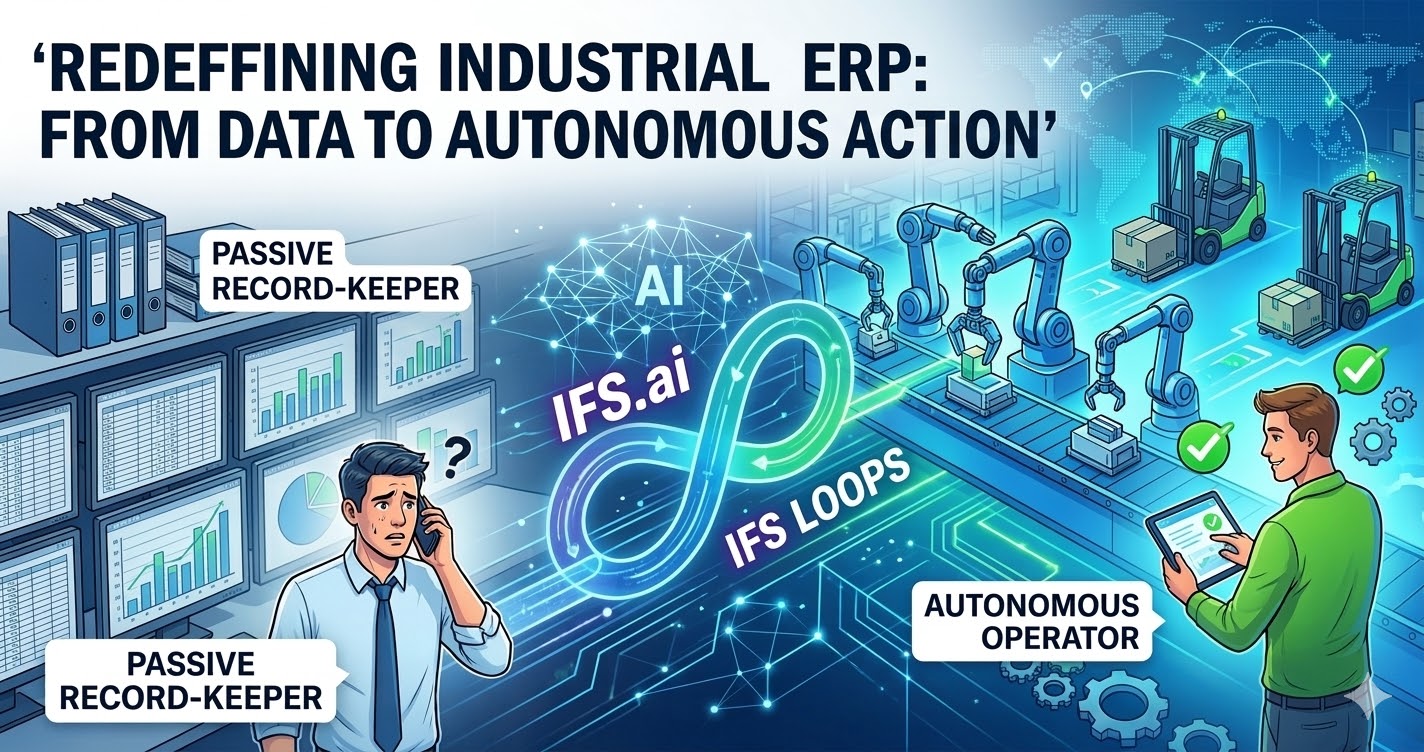
The Industrial AI Paradox is over.
For years, AI in manufacturing has been stuck on the same frustrating problem. Your ERP can predict a machine failure or a supply chain disruption with scary accuracy, but actually getting someone (or something) to do something about it? That part’s still manual, fragmented, and painfully slow. We’ve all been living in a world that’s data rich and execution poor.
That’s changing. With IFS.ai and the 2025 acquisition of TheLoops, now fully integrated as IFS Loops, ERP is becoming something fundamentally different: a system of action. Not just storing data and generating reports, but autonomously executing decisions, orchestrating operations, and closing the gap between “we saw it coming” and “we already handled it.”
This isn’t a feature update. It’s an architectural shift. And honestly, we think it changes the game for every organization running IFS.
1. IFS.ai: Intelligence Baked Into the Architecture
Here’s what IFS got right that most vendors didn’t: they refused to treat AI as a bolt on. Through IFS.ai, artificial intelligence isn’t sitting in a separate module you have to click into. It’s woven into the architecture itself. We’re not talking about chatbots or text summaries. This is industrial grade predictive and prescriptive logic, running across the entire platform.
What does that actually look like day to day? Picture a Logistics Manager’s morning:
- Before IFS.ai: The system records that a shipment is late. The manager finds out from a report (maybe hours later), manually traces the downstream impact on production, and starts making calls to figure out a workaround.
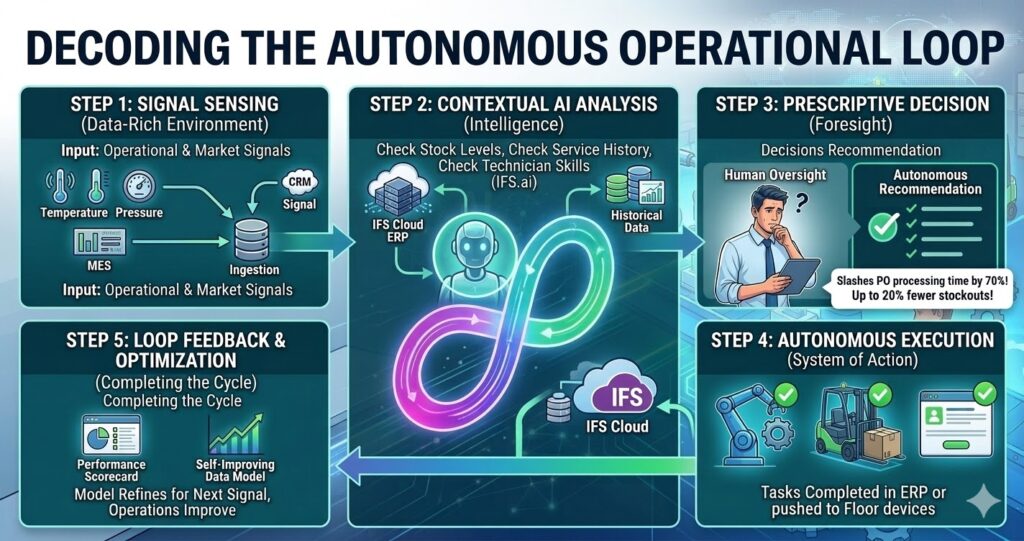
- With IFS.ai: The system has already analyzed that delay’s ripple effect on production schedules, checked the shelf life of the raw materials sitting in the warehouse, and recommended a specific rerouting strategy to minimize financial loss. All before the manager has finished their coffee.
This runs across everything: Enterprise Asset Management, Service Management, you name it. The ERP stops being the system that tells you what happened and starts being the system that tells you what to do next.
2. The Strategic Shift: Why IFS Acquired TheLoops
To understand where all of this is heading, you have to look at why IFS bought TheLoops in 2025.
Traditional ERP systems are systems of record. They store data. They report on things that already happened. They’re retrospective by design. But IFS Loops flips that model. It’s a system of action that autonomously executes multi system processes and makes context driven decisions while your people focus on the exceptions that actually need human judgment.
This wasn’t a feature acquisition. It was an architectural bet on the future of enterprise operations, and it puts IFS ahead of competitors who are still treating AI like a nicer dashboard.
3. IFS Loops: The Rise of the Digital Worker
This is where it gets really interesting. IFS Loops introduces Digital Workers: autonomous AI agents that can actually understand context, make decisions, and execute across your enterprise systems. These aren’t rigid RPA scripts following a flowchart. They dynamically plan and carry out complex tasks like order management, maintenance scheduling, and demand sensing.
Here are four Digital Workers and the real operational headaches they solve:
The Supplier Order Manager (Procurement Sentinel)
- The headache: A supplier changes a delivery date via email. Someone on your team has to read the notification, open the ERP, figure out the production impact, and manually update the purchase order. Every. Single. Time.
- The Loop: The Digital Worker catches that signal on its own. It spots a 48 hour delay, checks safety stock levels in IFS Cloud, and if it won’t risk a line stop, updates the PO and pings the planner. If it will risk a line stop, it flags it immediately for human intervention. No email gets buried. No delay goes unnoticed.
- What this means for your bottom line: Shorter procurement cycles, fewer surprise disruptions, and planners who spend time on strategy instead of data entry.
The Demand & Inventory Replenisher (Capital Optimizer)
- The headache: Replenishment decisions based on gut feeling or static reorder points that don’t account for seasonality, regional spikes, or market shifts. You end up with too much of the wrong stuff and not enough of what you actually need.
- The Loop: This agent watches consumption patterns against real market signals. When it spots a trend, say a sudden spike in demand for a specific spare part in one region, it autonomously kicks off a transfer order from the central hub to the local warehouse. Right part, right place, right time. No overstocking.
- What this means for your bottom line: Up to 20% fewer stockouts and PO processing time slashed by up to 70%.
The Maintenance Dispatcher (Uptime Guardian)
- The headache: A sensor flags something. Someone checks a dashboard. Someone else checks the schedule. A third person checks parts availability. By the time work gets assigned, you’ve already lost production hours.
- The Loop: When a vibration sensor hits a critical threshold, this Digital Worker checks who has the right skills and is available, verifies the part is in the warehouse, and drafts the Work Order. It triages your factory’s health in real time. No phone tag required.
- What this means for your bottom line: Faster repairs, higher uptime, and fewer of those “we didn’t catch it in time” moments that eat into margins.
The Customer Service Advocate (Experience Enhancer)
- The headache: “Where is my order?” Possibly the most repeated question in logistics, and one of the biggest time sinks for your team.
- The Loop: This agent tracks shipments. When something gets held up at a port, it recalculates the ETA and proactively updates the customer through the portal or email, often before they even know there’s a problem.
- What this means for your bottom line: Fewer inbound calls, happier customers, and a team that can focus on the accounts that actually need human attention.
The throughline here is simple: Digital Workers handle the routine coordination so your skilled people can stop chasing data and start making decisions that matter.
4. Closing the Last Mile: From AI Decision to Factory Floor Action
IFS Loops handles the thinking. But there’s a challenge even the smartest AI can’t solve from a server room: the physical “last mile” of industrial execution. Getting an intelligent decision out of the ERP and into the hands of someone standing on a shop floor, in a warehouse, or out in the field.
This is where the right execution layer makes all the difference, and it’s an area where JumpModel helps clients build real, measurable results. The goal is to make AI actionable in three ways that matter:
- Clean Data In, Smart Decisions Out: AI is only as good as the data feeding it. Solutions that use OCR to scan supplier invoices and normalize the data (converting “units” to “kilograms” based on your ERP logic) before it reaches IFS ensure that Digital Workers are acting on information you can trust. Garbage in, garbage out is still the number one risk with any AI initiative.
- Getting Insights to the People Who Need Them: A predictive maintenance alert is worthless if it stays in the back office. The execution layer needs to grab that AI trigger and push a guided workflow straight to a technician’s ruggedized mobile device. They see a clean, simple screen: here’s what’s wrong, here’s what to do, here are the parts you’ll need. The AI’s insight becomes a physical result on the factory floor.
- Connecting Your Messy Reality: Most manufacturers don’t run a single, clean tech stack. You’ve got legacy MES systems, third party CRMs, and a dozen other tools that weren’t designed to talk to each other. A proper integration layer bridges those gaps so an AI driven decision in IFS Loops can trigger an update in any of those systems. The autonomous loop doesn’t break just because your software landscape is complicated.
5. Turning Foresight Into Real Results
When you bring IFS.ai, IFS Loops, and a solid execution layer together, the value compounds in ways that go well beyond any single use case:
- Compliance You Don’t Have to Chase: A low code execution layer makes sure AI optimized schedules are actually followed. It forces mandatory inspections (temperature checks, pressure readings, safety verifications) at the exact right moment. Not “whenever someone remembers.” Every time, on time.
- Resilience When You’re Short Staffed: Digital Workers keep things running even when you can’t fill every role. Your people on the ground always know what to do next. The system routes them to the highest priority task based on what’s happening right now, not what was planned yesterday.
- A Supply Chain That Corrects Itself: When the ERP’s foresight connects to the physical movement of goods through your execution workflows, you get a supply chain that can absorb shocks, automatically rescheduling, reordering, and rerouting when reality doesn’t match the plan.
This isn’t dashboard AI. This is operational AI. The kind that actually does things.
The JumpModel Perspective
We’ve been watching this convergence take shape, and here’s our honest take: this is a structural shift that every IFS customer needs to be thinking about now, not next year.
ERP isn’t just the operational backbone anymore. It’s becoming the operational nervous system. Data turns into action. Workflows run themselves. And industrial organizations stop reacting to problems and start preventing them at scale.
The companies that move on this first will build an advantage that compounds over time. The ones that wait will still be managing complexity by hand while their competitors have already moved on.
We’d love to talk through what this means for your specific operations. Whether you’re just starting to explore Digital Workers or you’re looking to push your existing IFS Cloud investment further, reach out to the JumpModel team and we’ll help you build a realistic roadmap that fits where you are today and where you need to be.