IFS ERP Consulting: Implementation, Migration, AI, and Support for Asset-Intensive Enterprises
Enterprise organizations today are under increasing pressure to modernize operations, gain real-time visibility, and automate decision making across finance, supply chain, manufacturing, and asset management. For many organizations, IFS ERP has emerged as the platform of choice, particularly for asset-intensive industries such as manufacturing, aerospace & defense, energy, and utilities.
However, selecting the right software is only part of the equation. Long-term success depends on working with an experienced IFS consulting partner who understands not only the technology, but also the operational realities of complex enterprises.
In this article, we explore how an IFS ERP consulting firm supports organizations through IFS Cloud implementation, migration from legacy ERP systems, AI-driven optimization, and ongoing support.
Why Organizations Choose IFS ERP
IFS ERP is designed specifically for organizations that manage complex operations, projects, and physical assets. Unlike generalized ERP platforms, IFS excels in environments where asset lifecycle management, field service, and project-based operations are mission-critical.
Organizations commonly evaluate IFS when searching for:
- A modern SAP or Oracle ERP alternative
- A unified enterprise asset management (EAM) ERP
- A scalable cloud ERP for manufacturing
- An ERP platform with embedded AI and automation
As a result, searches for terms such as IFS ERP implementation, IFS Cloud partner, and IFS ERP system integrator continue to grow year over year.
The Role of an IFS ERP Consulting Partner
An experienced IFS ERP consulting company acts as both a technical and strategic partner throughout the ERP lifecycle. This includes:
- IFS ERP implementation planning and execution
- Business process design and optimization
- IFS Cloud configuration and integration
- Data migration and system modernization
- Post-go-live support and managed services
Unlike generic ERP consultancies, a specialized IFS consulting firm understands the platform’s industry specific strengths and how to align them with real operational outcomes.
IFS ERP Implementation & IFS Cloud Consulting
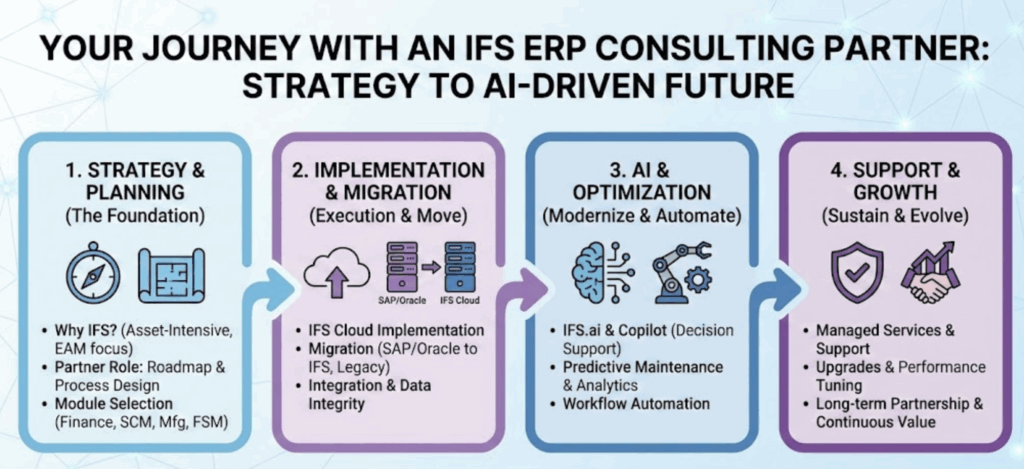
A successful IFS Cloud implementation begins with a clear roadmap. Leading organizations typically engage an IFS ERP implementation partner to assist with:
- ERP implementation strategy and timeline planning
- IFS module selection (Finance, Supply Chain, Manufacturing, EAM, FSM)
- Integration with legacy and third-party systems
- Cloud migration and security design
- User adoption and change management
Many buyers also search for guidance around IFS ERP implementation cost, timelines, and best practices, making early consulting involvement critical to avoiding overruns and scope creep.
ERP Migration: SAP to IFS and Oracle to IFS
A significant percentage of new IFS customers come from legacy platforms. Common migration scenarios include:
- SAP to IFS migration
- Oracle to IFS migration
- Legacy on prem ERP modernization
- ERP cloud migration initiatives
Organizations exploring ERP replacement are often driven by rising costs, rigid architectures, or poor alignment with asset-intensive workflows. An experienced IFS system integrator ensures data integrity, minimizes downtime, and aligns the new ERP environment with future growth.
Industry-Focused IFS ERP Solutions
IFS is purpose built for industries where traditional ERP systems struggle.
Manufacturing ERP
IFS provides advanced capabilities for:
- Discrete manufacturing ERP environments
- Complex supply chain management
- Manufacturing execution systems (MES)
- Project based manufacturing operations
This makes IFS manufacturing ERP a strong choice for industrial and engineering-driven organizations.
Asset-Intensive & EAM-Driven Industries
IFS is widely adopted for:
- Enterprise asset management (EAM)
- Predictive maintenance and lifecycle tracking
- Utilities, energy, and infrastructure operations
- Aerospace and defense ERP requirements
Organizations searching for asset intensive ERP software or EAM ERP solutions often find IFS uniquely aligned to their needs.
IFS.ai, Copilot, and AI-Driven ERP Automation
With the introduction of IFS.ai, the platform has evolved into an AI enabled ERP designed for autonomous decision support. Key innovations include:
- ERP workflow automation
- AI driven forecasting and planning
- Predictive maintenance analytics
- Natural language ERP copilots
- Embedded decision intelligence
As interest grows in AI ERP software and autonomous ERP platforms, IFS is positioning itself at the forefront of enterprise AI adoption.
IFS ERP Support, Managed Services & Optimization
ERP value does not end at go live. Many organizations actively seek:
- IFS ERP support services
- IFS managed services
- IFS Cloud upgrades
- Performance optimization and enhancement
- Ongoing functional and technical support
A long-term IFS support partner ensures system stability, continuous improvement, and alignment with evolving business needs.
Choosing the Right IFS Consulting Firm
When evaluating an IFS ERP consulting partner, organizations should consider:
- Proven experience in IFS ERP implementations
- Industry-specific expertise
- Cloud and AI capabilities
- Post-implementation support offerings
- Ability to support ERP modernization and migration
Whether you are planning a new IFS Cloud implementation, replacing SAP or Oracle, or optimizing an existing environment, the right consulting partner can significantly impact outcomes.
Final Thoughts
IFS ERP continues to gain traction as a leading solution for asset intensive and manufacturing enterprises seeking modern, AI-enabled ERP capabilities. However, the platform’s full value is realized only when paired with expert consulting, thoughtful implementation, and long-term support.
For organizations searching for an IFS ERP partner, IFS Cloud consulting, or IFS ERP implementation services, working with a specialized firm ensures that technology investments translate into measurable business results.