IFS ERP Solutions: What Every Organization Should Know Before Choosing an IFS Integrator
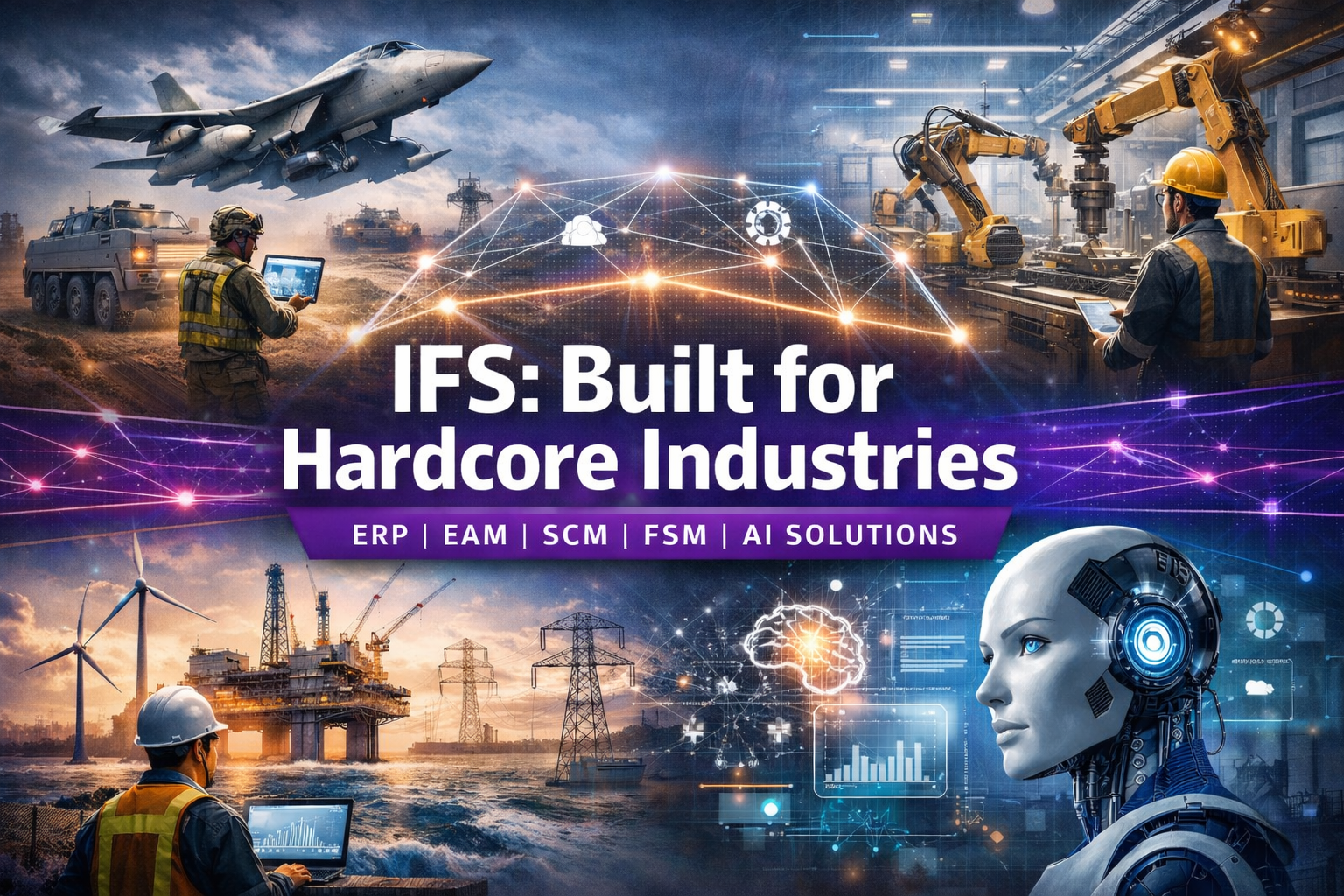
The enterprise software market has never been more crowded. Yet for organizations in asset-intensive and service-centric industries, the field narrows considerably when the requirements become real. Complex project delivery, asset lifecycle management, workforce optimization, regulatory compliance across borders: these are not problems solved by generic platforms bolted together with middleware. This is precisely where IFS has built its position, and why the choice of an IFS integrator matters more than most executives realize.
This article outlines what IFS is, how IFS ERP solutions serve industries from defense to utilities to manufacturing, what IFS AI brings to the table, and why working with the right IFS experts determines whether an implementation drives measurable results or becomes another line item on the write-off ledger.
What Is IFS? A Platform Built for Hardcore Industries
For those asking what is IFS, the short answer: IFS is a Swedish-headquartered enterprise software company that develops IFS Cloud, a composable platform unifying Enterprise Resource Planning (ERP), Enterprise Asset Management (EAM), Supply Chain Management (SCM), and Field Service Management (FSM) under a single architecture. The long answer is more interesting.
Unlike horizontal ERP vendors that attempt to serve every industry with the same toolset, IFS was purpose-built for organizations where profit margins depend on asset uptime, complex project delivery, and service excellence. Visit ifs.com and the positioning is explicit: “AI-Powered Software Built for Your Industry.” That is not a tagline. It is an architectural decision that permeates every module, every workflow, every AI model the platform deploys.
IFS Cloud (currently in its 25-series release cycle) is not a legacy system with a cloud wrapper. It is a composable platform designed for organizations that need to unify assets, operations, and service without sacrificing the depth required by regulated, complex, and mission-critical environments.
IFS currently manages over $2.4 trillion in critical assets across 30+ countries. The customer base spans organizations that service, power, and protect critical infrastructure globally.
IFS ERP: More Than Traditional Enterprise Resource Planning
When evaluating an IFS ERP solution against competitors like SAP S/4HANA, Microsoft Dynamics 365, or Oracle, the differentiation becomes clear at the architectural level.
A traditional IFS ERP solution covers the expected ground: financials, procurement, production planning, inventory management, and demand forecasting. Where the IFS ERP platform diverges is in its native integration with asset management, field service, and supply chain execution. These are not bolt-on modules purchased separately and stitched together through integration layers. They are native capabilities within the same data model.
Why This Matters for Your Organization
Consider a defense contractor managing a multi-year sustainment program. The IFS ERP solution handles contract accounting, progress billing, and earned value management within the same platform that schedules maintenance, dispatches field technicians, and tracks component serialization. No middleware. No reconciliation between disconnected systems. One source of truth from the boardroom to the hangar floor.
This architectural coherence is what drives IFS results that organizations can actually measure: reduced unplanned downtime, improved first-time fix rates, compressed order-to-delivery cycles, and margin improvement that flows directly to the bottom line.
Key IFS ERP Capabilities
- Financials and project accounting with multi-entity, multi-currency, and multi-GAAP support
- Production planning across discrete, process, and mixed-mode manufacturing
- Procurement and supply chain management with native warehouse execution (strengthened by the March 2026 Softeon acquisition)
- Enterprise Asset Management with full lifecycle tracking from design through decommission
- Field Service Management with intelligent scheduling, mobile workforce enablement, and IoT integration
- Human Capital Management for workforce planning and skills-based resource allocation
IFS Solutions Across Core Industries
The depth of IFS solutions becomes most apparent when examined through the lens of the industries they serve. Three sectors stand out as areas where IFS has established dominant positioning.
IFS Defense and Aerospace
IFS defense capabilities represent one of the platform’s longest-standing areas of strength. Defense organizations operate under constraints that most enterprise software cannot accommodate: ITAR compliance, complex contract structures (FFP, CPFF, T&M), progress billing against milestones, and multi-decade sustainment programs where configuration management is non-negotiable.
IFS has supplied defense contract management digital solutions for decades. The platform empowers aerospace and defense manufacturers with AI-driven lifecycle visibility, compliance tools, supply chain resilience, and connected operations across the full product lifecycle. For IFS defense customers, the platform handles:
- Defense contract reporting and supplier classification
- Earned value management (EVM) and contract performance measurement
- Serialized component tracking and configuration management
- MRO (Maintenance, Repair, and Overhaul) optimization
- Export control and ITAR/EAR compliance frameworks
Organizations operating in the defense sector require an IFS integrator with security clearances, domain expertise, and an understanding of compliance frameworks that most technology consultancies simply do not possess.
IFS Manufacturing
IFS manufacturing capabilities address the full spectrum of production environments: discrete, process, repetitive, and engineer-to-order. Where the platform distinguishes itself is in complex manufacturing scenarios where standard MRP logic breaks down.
For aerospace component manufacturers running mixed-mode production, IFS manufacturing provides:
- Advanced planning and scheduling with constraint-based optimization
- Quality management integrated directly into production workflows
- Lot and serial traceability from raw material receipt through finished goods shipment
- Engineering change management with effectivity date control
- Demand-driven MRP (DDMRP) for environments with high variability
The IFS results in manufacturing environments are quantifiable: reduced WIP inventory, improved on-time delivery, fewer quality escapes, and tighter integration between engineering and production that eliminates the information gaps where margin evaporates.
IFS Utilities and Energy
IFS utilities solutions serve power generation, transmission and distribution, water, gas, oil and gas, and mining operations. These are environments where asset failure carries consequences measured in safety incidents, regulatory penalties, and community impact, not merely lost revenue.
The IFS utilities platform maximizes asset and workforce optimization across the full asset lifecycle. Capabilities include:
- Predictive maintenance powered by IFS AI and IoT sensor integration
- Regulatory compliance management for NERC, FERC, and regional frameworks
- Outage management with intelligent crew dispatch
- Linear asset management for pipelines, transmission lines, and distribution networks
- Sustainability tracking and environmental compliance reporting
For utility organizations, the choice of IFS solutions and the IFS integrator who deploys them directly impacts public safety, regulatory standing, and operational continuity.
IFS AI: Industrial Intelligence That Takes Action
The conversation around enterprise AI often feels detached from the bottom line. Most vendors have added conversational copilots that help draft emails or summarize documents. IFS AI takes a fundamentally different approach.
IFS AI, delivered through the IFS.ai framework, is Industrial AI purpose-built to take action inside critical processes. This is not a chatbot layered on top of an ERP. It is contextual intelligence, governed digital workers, and advanced AI-decisioning embedded directly into operational workflows.
What IFS AI Actually Does
Where generic AI generates text, IFS AI generates outcomes:
- Predicts turbine failures based on vibration anomaly patterns before unplanned downtime occurs
- Optimizes technician routes to reduce fuel costs and improve first-time fix rates
- Automates supply chain responses to weather events, demand shifts, and supplier disruptions
- Extracts purchase order data from uploaded PDFs, reducing manual registration while improving accuracy
- Orchestrates warehouse robotics for autonomous execution within complex fulfillment environments
IFS AI is multimodal, capable of interpreting and reasoning across text, imagery, audio, and sensor data. The platform does not simply surface insights for human review. It plans, decides, and acts across connected systems within governed parameters.
According to IFS, 2026 is “the year AI stops generating headlines and starts quietly running operations.” For organizations evaluating IFS solutions, this distinction between performative AI and operational AI represents one of the most significant decision criteria in the current market.
The IFS AI Advantage Over Competitors
The IFS AI approach differs from SAP’s Joule and Microsoft’s Copilot in a critical dimension: domain specificity. While horizontal AI assistants are trained on general business data, IFS AI models are trained on industrial asset data, maintenance histories, and operational patterns specific to the industries IFS serves. This means the AI does not need to be taught what a vibration anomaly means for a gas turbine or why a particular failure mode in a substation transformer requires immediate intervention. It already knows.
The Role of an IFS Expert in Successful Implementations
Enterprise software implementations fail at rates that should concern every executive sponsor. The technology is rarely the root cause. The failure almost always traces back to implementation methodology, organizational change management, and the depth of industry expertise brought by the IFS expert team leading the project.
What Separates Great IFS Experts from Average Ones
An IFS expert worth the engagement brings three things to every project:
- Deep platform knowledge: Understanding not just what IFS Cloud can do out of the box, but where the boundaries of configuration end and where customization begins. The best IFS experts keep organizations within the platform’s upgrade path, avoiding the technical debt that cripples long-term ROI.
- Industry domain expertise: An IFS integrator deploying IFS Cloud for a defense contractor needs to understand DCAA audit requirements, ITAR compliance, and earned value reporting at a level that goes beyond surface familiarity. Similarly, an IFS expert working in utilities must understand NERC CIP cybersecurity standards and the operational realities of grid management.
- Organizational change management: The most technically flawless implementation delivers zero value if the workforce does not adopt the platform. Experienced IFS experts build adoption strategies into the project plan from day one, not as an afterthought in the final sprint.
Choosing the Right IFS Integrator
The IFS integrator landscape includes global systems integrators operating across multiple regions, regional specialists with deep local market knowledge, and independent software vendors (ISVs) that extend IFS Cloud capabilities with industry-specific solutions.
When selecting an IFS integrator, organizations should evaluate:
- Verified IFS partnership status: Confirm through ifs.com or the IFS Partner Finder that the integrator holds current certification
- Industry-specific project references: Ask for references in your specific sector, not adjacent industries
- Technical team continuity: Ensure the IFS experts presented during the sales process are the same team that will execute the implementation
- Post-go-live support model: Understand whether the IFS integrator offers ongoing IFS support or transitions you to a separate team
- Upgrade methodology: Evaluate how the integrator approaches IFS Cloud version upgrades and continuous updates
The best IFS integrators function as strategic advisors, not just technical implementers. They understand that an IFS ERP solution is a business transformation, not an IT project.
IFS Support: Maintaining Momentum After Go-Live
Go-live is not the finish line. It is the starting line. Organizations that underinvest in IFS support after deployment consistently underperform against their business case projections.
Effective IFS support operates at multiple levels:
Tier 1: Operational Support
Day-to-day user assistance, break-fix resolution, and incident management. This is the foundation of any IFS support model and should be available through defined SLAs with response times aligned to business criticality.
Tier 2: Application Management
Configuration changes, workflow modifications, report development, and minor enhancements that keep the platform aligned with evolving business processes. This level of IFS support requires certified IFS experts who understand both the platform and the business context.
Tier 3: Strategic Optimization
Continuous improvement initiatives, new module activation, AI capability expansion, and version upgrade planning. This is where IFS support transitions from maintenance to value creation, and where the relationship with your IFS integrator pays the highest dividends.
Organizations should establish their IFS support model before go-live, not after. The transition from implementation to operations is where many deployments lose momentum, and where the right IFS managed service partner makes the difference between a platform that stagnates and one that compounds value over time.
IFS Managed Service: The Case for Outsourced Excellence
The IFS managed service model has gained significant traction as organizations recognize that maintaining deep IFS platform expertise in-house is both expensive and unnecessary for most operational scenarios.
An IFS managed service engagement typically covers:
- Functional and technical issue resolution with defined SLAs
- Proactive monitoring of system health, performance, and security
- Continuous optimization to leverage new IFS Cloud capabilities as they are released
- User training and enablement to drive adoption and reduce support volume
- Upgrade planning and execution to keep the platform current without disrupting operations
Why IFS Managed Services Deliver Stronger Results
The commercial implications of an IFS managed service model are straightforward. Rather than recruiting, training, and retaining a full-time team of IFS experts, organizations access a shared pool of certified professionals who work across multiple IFS environments daily. This delivers:
- Broader exposure: IFS managed service teams encounter and resolve a wider variety of issues than any single in-house team, building pattern recognition that accelerates resolution times
- Cost predictability: Fixed monthly fees replace the unpredictable costs of recruiting, attrition, and training
- Faster access to new capabilities: IFS managed service providers are typically among the first to certify on new IFS Cloud releases, giving their clients early access to new IFS AI capabilities and platform enhancements
- Scalability: Support capacity scales with business needs without the lead time of hiring
The IFS managed service market continues to mature, with partners like Baker Tilly and regional specialists offering models tailored to specific industries and organizational sizes. In 2026, NEC and IFS announced a joint initiative deploying IFS Cloud managed services for the Japanese market, reflecting the growing global demand for outsourced platform excellence with data sovereignty guarantees.
Measuring IFS Results: What Good Looks Like
Every IFS ERP investment should be measured against a defined business case. The organizations that achieve the strongest IFS results share common characteristics:
Quantifiable Outcomes Organizations Report
- 15-30% reduction in unplanned downtime through predictive maintenance powered by IFS AI
- 20-40% improvement in first-time fix rates via intelligent scheduling and mobile workforce enablement
- 10-25% reduction in inventory carrying costs through demand-driven planning and unified supply chain visibility
- Compressed order-to-delivery cycles by eliminating handoffs between disconnected systems
- Improved audit readiness through single-source-of-truth data architecture
What Drives Strong IFS Results
The organizations achieving the best IFS results consistently invest in three areas:
- Selecting the right IFS integrator: The implementation partner determines the trajectory of the entire program. Organizations that choose an IFS integrator based on lowest cost rather than deepest expertise almost always pay more in the long run through rework, scope creep, and delayed value realization.
- Committing to organizational change management: Technology adoption is a human challenge, not a technical one. The best IFS results come from organizations that invest in training, communication, and executive sponsorship throughout the implementation lifecycle.
- Establishing ongoing IFS support and optimization: The gap between what IFS Cloud can do and what most organizations use it to do is substantial. Closing that gap through continuous optimization, whether through internal teams or an IFS managed service partner, is where compounding value emerges.
The IFS Ecosystem in 2026: What Has Changed
Several developments have reshaped the IFS landscape in 2026:
The Softeon Acquisition
In March 2026, IFS completed its acquisition of Softeon, a tier-1 warehouse management software (WMS) provider with 20+ years of domain expertise. Operating as IFS Softeon, this combination addresses one of the most persistent pain points in supply chain operations: the disconnect between ERP and WMS systems that creates costly blind spots.
IFS Softeon customers include Brooks, Casey’s, Denso, Sony, and UPS, processing millions of orders monthly across warehouse operations in 30 countries. The integration brings robotics orchestration, advanced warehouse execution, and unified visibility from boardroom to warehouse floor within the IFS ERP platform.
For organizations evaluating IFS solutions in 2026, this acquisition significantly strengthens the supply chain management capabilities and eliminates a common integration challenge.
IFS.ai Maturation
IFS AI has moved beyond pilot programs and proof-of-concept deployments into production-scale operations. The platform’s Industrial AI models now support autonomous agents that plan, decide, and act across connected systems. This represents a fundamental shift from AI as a decision-support tool to AI as an operational participant.
Expanding Global Managed Services
The IFS managed service ecosystem has expanded globally, with the NEC partnership opening the Japanese market and regional providers establishing stronger coverage across EMEA, APAC, and the Americas.
Making the Decision: Is IFS Right for Your Organization?
For organizations operating in defense, aerospace, utilities, energy, manufacturing, or complex service environments, IFS should be on the shortlist. The question is not whether the platform has the capabilities. It is whether the implementation will be executed with the precision these industries demand.
The organizations that achieve the strongest IFS results approach the decision with clarity on three fronts:
- Platform fit: Does the IFS ERP solution natively support your industry’s requirements, or will it require extensive customization? For defense, utilities, and manufacturing, the answer is almost always native support.
- Partner selection: Is the IFS integrator you are evaluating staffed with IFS experts who have delivered in your specific industry, or are they learning on your project?
- Long-term operating model: Have you planned for ongoing IFS support, whether through internal teams or an IFS managed service engagement, that will drive continuous optimization after go-live?
The IFS partner ecosystem, accessible through ifs.com, includes global systems integrators, regional specialists, and ISVs that extend the platform with industry-specific capabilities. The right combination of platform, partner, and operating model is what separates transformative IFS results from implementations that merely replace one system with another.
Next Steps
The commercial implications of an IFS ERP investment extend well beyond the implementation itself. Organizations that approach this decision with the rigor it deserves, selecting the right IFS integrator, engaging credentialed IFS experts, establishing robust IFS support, and planning for continuous optimization through an IFS managed service model, position themselves to capture value that compounds over years, not quarters.
If your organization is evaluating IFS solutions, exploring IFS AI capabilities, or seeking an IFS integrator with the industry depth your environment demands, the conversation should start with specifics: your operational challenges, your compliance requirements, your definition of success.
Let’s discuss how IFS Cloud applies to your organization’s specific context and what a phased roadmap toward measurable IFS results could look like.