The Industrial AI Imperative: A Framework for IFS.ai Readiness

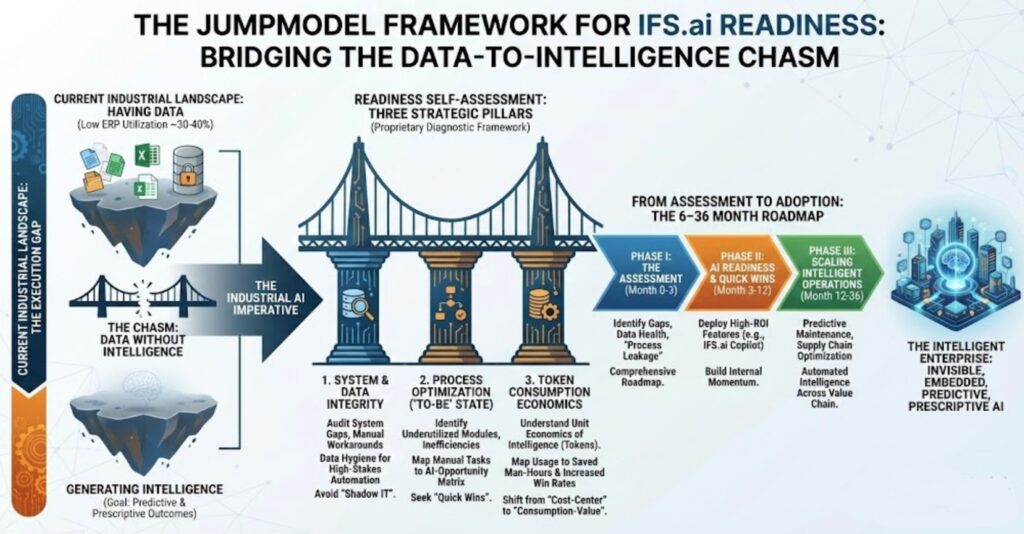
In the current industrial landscape, the chasm between “having data” and “generating intelligence” has become the primary determinant of competitive advantage. While many organizations operating on IFS Cloud have recognized the theoretical potential of Artificial Intelligence, our observations suggest a significant execution gap. Most enterprises utilize a mere 30% to 40% of their existing ERP capabilities, leaving the vast majority of their operational investment dormant.
As IFS.ai moves from the periphery to the core of enterprise strategy, the question for leadership is no longer if AI should be deployed, but rather where the foundation is sufficiently stable to support it.
The Four Archetypes of AI Maturity
Through our diagnostic work at JumpModel, we have identified four distinct archetypes of IFS customers in their AI journey:
- The Laggards: Organizations burdened by technical debt and legacy processes, often too far behind to consider advanced automation.
- The Experimenters: Companies exploring AI in isolated pockets, often with “pilot purgatory” results that fail to scale.
- The Fragmented: Those using AI incorrectly—investing in “chatbot-style” tools that lack the deep operational context required for industrial excellence.
- The Intelligent Enterprise: Organizations where AI is invisible, deeply embedded, and driving predictive, prescriptive outcomes.
The goal of the IFS.ai Starter Program is to provide a structured path from the first three categories to the fourth.
The Readiness Self-Assessment: Three Strategic Pillars
To determine if an organization is prepared for the IFS.ai layer, we utilize a proprietary diagnostic framework centered on three pillars:
1. System and Data Integrity AI is only as effective as the data architecture it sits upon. A readiness assessment must audit for system gaps and manual workarounds that bypass the ERP. If your data is trapped in “shadow IT” or Excel spreadsheets, the AI engine lacks the fuel to provide accurate predictions. Our Data Readiness Scorecard evaluates whether your current data hygiene supports high-stakes automation, such as Business Opportunity Prediction or Lead Scoring.
2. Process Optimization (The “To-Be” State) Deploying AI on top of a broken process only accelerates failure. Before activating IFS.ai features like the CRM Panel Contact Creation Automation, organizations must identify underutilized modules and process inefficiencies. A readiness assessment maps current manual tasks against the AI-Opportunity Matrix to identify “quick wins”—high-impact, low-complexity automations that prove the value proposition.
3. Token Consumption Economics A sophisticated AI strategy requires an understanding of the unit economics of intelligence. In the IFS ecosystem, this is measured via “Tokens.” For instance, a Customer Contact Automation scan may consume 50 tokens, while training a Business Opportunity Prediction model may require 100. Leaders must move from a “cost-center” mindset to a “consumption-value” model, where token usage is mapped directly to saved man-hours and increased win rates.
From Assessment to Adoption: The 6–36 Month Roadmap
A successful transition to an AI-augmented operation is not an event; it is a multi-year transformation. The JumpModel approach breaks this into a clear, three-step evolution:
- Phase I: The Assessment (Month 0-3): Identifying the gaps, data health, and “process leakage” within the existing IFS footprint.
- Phase II: AI Readiness & Quick Wins (Month 3-12): Deploying high-ROI features such as the IFS.ai Copilot for Sales to build internal momentum.
- Phase III: Scaling Intelligent Operations (Month 12-36): Integrating predictive maintenance, supply chain optimization, and automated intelligence across the entire asset-intensive value chain.
The JumpModel Perspective
At JumpModel, we operate at the intersection of industrial expertise and IFS specialization. We believe that Industrial AI is fundamentally different from generic Enterprise AI—it requires a “context-aware” approach that understands the specific nuances of asset-intensive operations.
Our Assessment doesn’t just deliver a report; it provides a comprehensive roadmap—from 50-page deep dives to technical integration diagrams—designed to turn your ERP into a real performance engine.
Is your organization ready for the intelligence era? The journey begins with an honest assessment of the current state. We only move forward when the plan makes strategic and financial sense.