The Industrial AI Imperative: Separating Substance from Shadow in the IFS.ai Suite

In the current industrial landscape, “AI” has transitioned from a future-state aspiration to a boardroom mandate. However, for organizations operating on IFS Cloud, the challenge is no longer the availability of AI, but the discernment of its value. As enterprises are deluged with promises of “transformative intelligence,” a critical question emerges for the modern COO and CIO: What in the IFS.ai suite is operational substance, and what is merely marketing “fluff”?
At JumpModel, we observe that many IFS customers utilize only 30–40% of their existing system’s capabilities. Adding a layer of AI to an under-optimized ERP is not a strategy—it is a cost. To drive real performance, organizations must move beyond experimentation and focus on Embedded Intelligence.
1. The Taxonomy of “Fluff” vs. “Real” AI
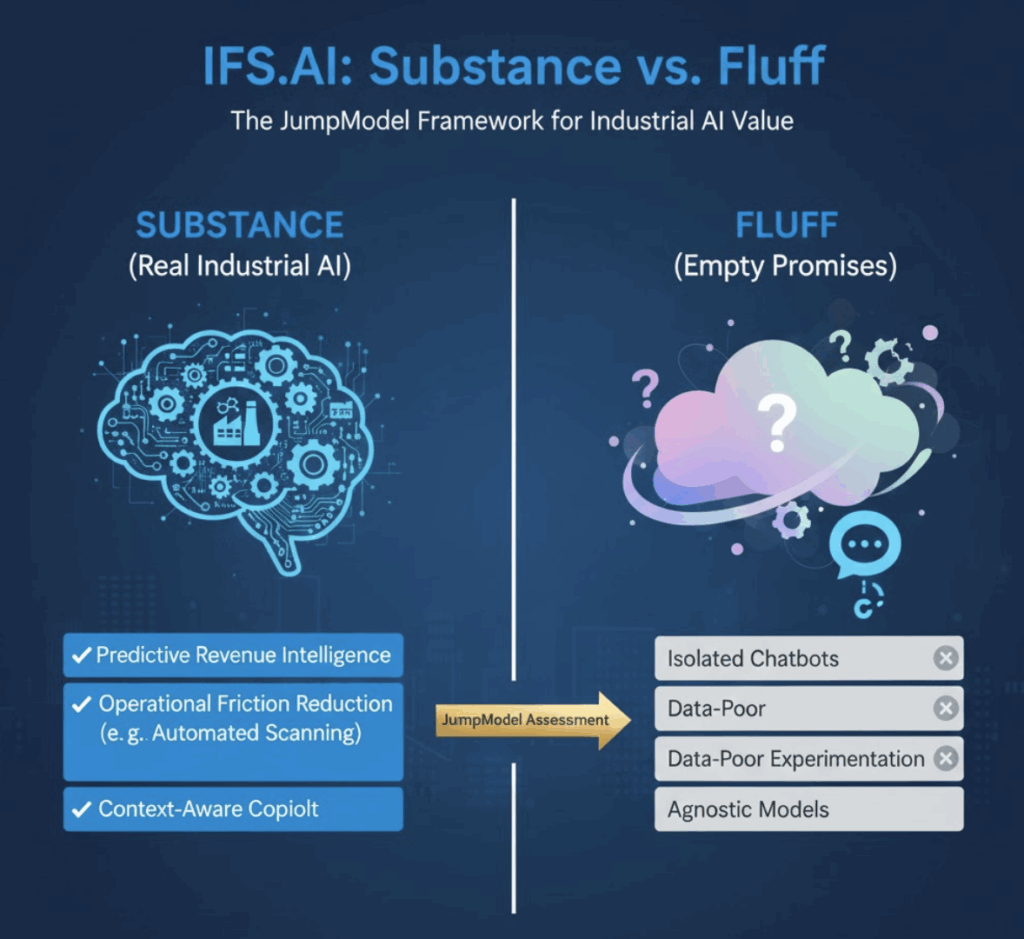
In the ERP domain, “fluff” refers to AI applications that are disconnected from core business logic—features that provide “interesting” insights without driving “actionable” outcomes. Conversely, “Real AI” (or Industrial AI) is deeply embedded, context-aware, and predictive.
The “Fluff” Indicators:
- Isolated Chatbots: Generative AI that lacks access to real-time transactional data or process context.
- Data-Poor Experimentation: AI models launched without a foundational “Data Readiness Scorecard.”
- Agnostic Models: AI built for generic office work, rather than the specific complexities of asset-intensive industries.
The Substance: High-Impact IFS.ai Use Cases
Based on our analysis of the current IFS.ai ecosystem, several “non-fluff” capabilities stand out for their ability to deliver immediate ROI:
- Predictive Revenue Intelligence: The Business Opportunity Prediction and Lead Prediction models allow sales teams to move from intuition to data-driven forecasting. By analyzing historical “Won/Lost” data, IFS.ai generates a probability score (0-100), enabling precise resource allocation.
- Operational Friction Reduction: Features like Customer Contact Automation (scanning business cards/emails) and CRM Panel Automation are not just “neat” features—they are high-frequency value levers that eliminate manual data entry errors and reclaim hundreds of man-hours.
- The IFS.ai Copilot: Unlike generic LLMs, the IFS.ai Copilot is designed to be context-aware, uncovering insights from historical interactions and recommending specific realignments for sales and supply chain efforts.
2. The JumpModel Framework: Bridging the “Value Gap”
Our experience across the West Coast industrial sector shows that AI success is a function of system hygiene. Most companies fall into a “Value Gap”—they are either too far behind to consider AI or are using it in isolated pockets that don’t move the needle.
To move toward a state where AI is invisible, deeply embedded, and delivering value, JumpModel employs a rigorous three-step assessment:
- System & Data Audit: We identify the “noise” in your current IFS environment—manual workarounds, data gaps, and underutilized modules. AI cannot fix a broken process; it only accelerates it.
- AI-Opportunity Matrixing: We map your specific pain points to the IFS.ai model library. We look for “Quick Wins” (e.g., automated scanning or predictive KPIs) that can be deployed within 6 months.
- Token Consumption Strategy: Understanding the economics of AI is vital. Whether it is 40 tokens for a contact creation or 100 tokens for training a predictive model, we help you build a “Token Budget” aligned with your ROI goals.
3. Strategic Imperatives for the Road Ahead
For organizations looking to lead in the era of Intelligent Operations, we recommend three immediate actions:
- Prioritize Predictive over Generative: While GenAI is visible, Predictive models (maintenance, supply chain, and CRM) drive the core of industrial profitability.
- Audit Your Data Health: Your AI is only as good as the “Closed” business data it trains on. If your historical data is fragmented, your predictions will be flawed.
- Build a Multi-Year Roadmap: AI is not a project; it is a 6-to-36 month journey. Start with an assessment that identifies where AI fits today and where it scales tomorrow.
The Bottom Line
The “fluff” in AI is the noise of the market. The “substance” is the performance engine that IFS.ai provides when connected to a healthy, fully-utilized ERP foundation.
At JumpModel, we help you connect those dots. We only succeed if the plan makes operational sense. If you are ready to stop experimenting and start optimizing, let’s define your roadmap to intelligent operations.