The Operational Digital Core: Why 2026 Marks a Turning Point for Enterprise Platforms
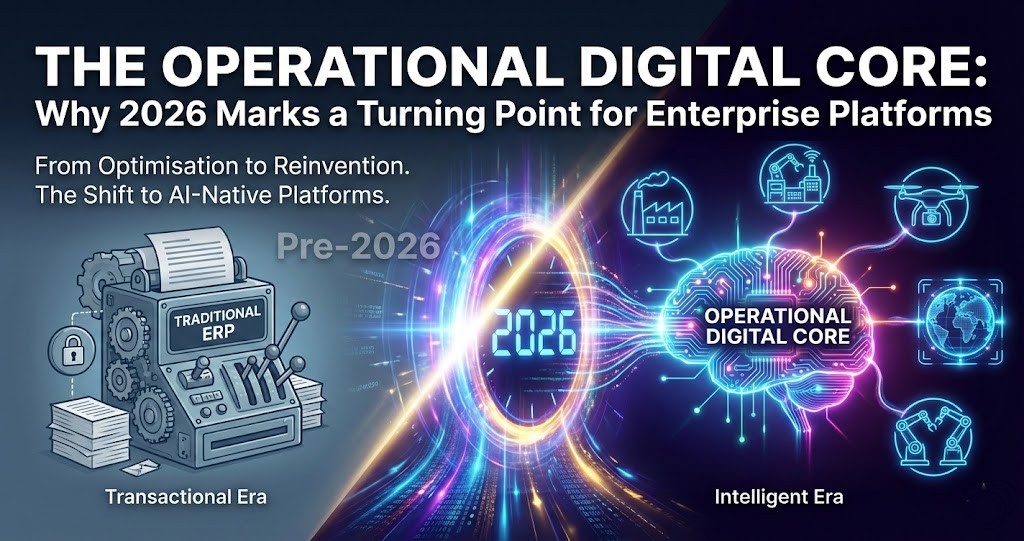
The enterprise platform landscape is undergoing one of its most significant structural shifts in decades. We believe this marks a turning point—not merely an incremental evolution, but a fundamental reimagining of what enterprise systems can and should deliver.
Most large organisations continue to rely on ERP systems designed for a transactional era: optimised for data entry, process compliance, and financial control. While these foundations remain essential, they are increasingly misaligned with the demands of modern operations.
1. The Commercial Case for Change
Today’s operating environment presents challenges that traditional ERP architectures were never designed to address:
- Assets are more connected — generating operational data that demands real-time response
- Services are more contracted — shifting value from product delivery to outcome achievement
- Workforces are more distributed — requiring seamless coordination across geographies and functions
- Customers expect outcomes, not processes — fundamentally altering how value is measured and delivered
Disruption driven by climate pressures, supply chain volatility, workforce constraints, and persistent inflation has become a constant rather than an exceptional occurrence. The commercial implications extend beyond operational efficiency—organisations that fail to adapt risk margin erosion, competitive disadvantage, and an inability to meet evolving customer expectations.
2. Why Traditional ERP Models Are Under Pressure
Macroeconomic and operational pressures are exposing the limitations of legacy enterprise systems at an accelerating pace.
The data points are compelling:
| Challenge | Impact on Traditional ERP |
|---|---|
| Persistent inflation | Demands real-time cost visibility and dynamic pricing capabilities |
| Supply chain fragility | Requires predictive sensing and rapid response orchestration |
| Labour shortages | Necessitates intelligent scheduling and workforce optimisation |
| Digital expectations | Leaders expect decision support, not just reporting |
Industry analysts are pointing to structural change. Gartner predicts that by the end of 2026, 40% of enterprise applications will include integrated task-specific AI agents, up from less than 5% today. IDC warns that legacy systems and siloed data remain among the biggest barriers to AI effectiveness—highlighting how traditional architectures can actively slow progress toward intelligent operations.
What is becoming clear: transactional systems alone are no longer sufficient. Organisations need platforms capable of sensing change, responding in real time, and optimising performance across assets, services, and people.
3. Four Shifts That Will Define Enterprise Platforms in 2026
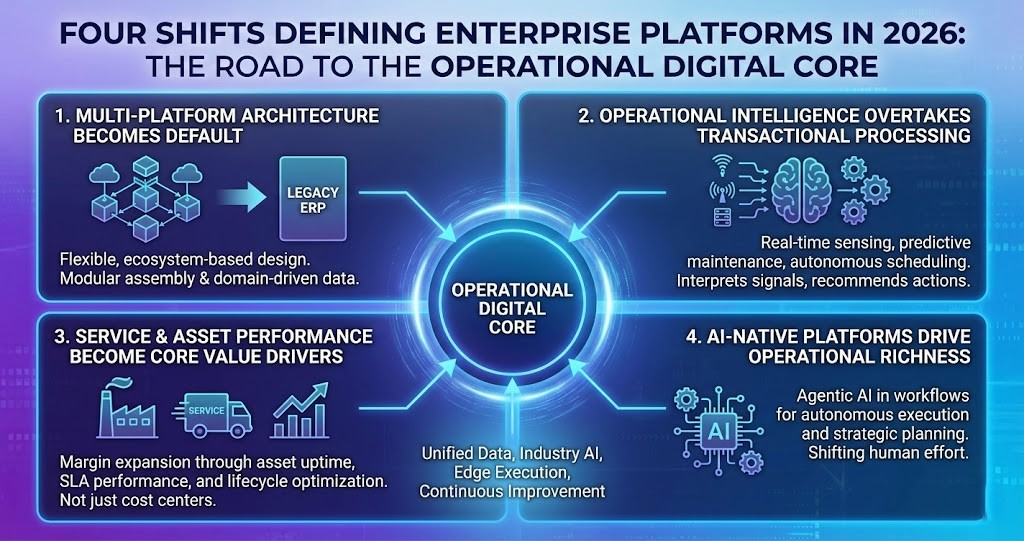
Multi-Platform Architecture Becomes the Default
The shift away from monolithic ERP architectures has been underway for more than a decade, but adoption is accelerating. Rather than relying on a single system to standardise every process, organisations are increasingly favouring:
- Process redesign from the ground up — eliminating non-value-adding steps before automation
- Modular capability assembly — enabling ecosystem-based design and best-of-breed selection
- Domain-driven data ownership — supporting business-unit autonomy through API-first governance
For operational leaders, this architectural shift enables faster response to change. For finance leaders, it improves transparency without sacrificing control. For IT teams, it marks a move away from rigid platforms toward governed flexibility.
Operational Intelligence Overtakes Transactional Processing
The next phase of enterprise transformation is not process automation—it is operational intelligence.
Capabilities that were once considered advanced are becoming baseline requirements:
- Anomaly detection across asset and service operations
- Predictive maintenance driven by real-time sensor data
- Autonomous scheduling that responds to changing conditions
- Continuous optimisation across interconnected workflows
Leaders no longer want systems that simply execute predefined processes. They want platforms that can interpret operational signals, recommend actions, and increasingly act autonomously within defined parameters.
Service and Asset Performance Become Core Value Drivers
Across asset-intensive industries, service and asset performance are no longer viewed purely as cost centres. In 2026, organisations will increasingly link margin expansion and competitive differentiation to:
- Asset uptime and availability metrics
- SLA performance tied to contracted outcomes
- Service profitability at the individual contract level
- Lifecycle cost optimisation across asset populations
Traditional ERP systems, designed primarily for financial reporting, lack the operational depth required to manage these requirements alone. Organisations that adopt integrated platforms connecting strategic investment planning, asset design, service execution, and performance management will find themselves better positioned to extract value across the entire asset and service lifecycle.
AI-Native Platforms Drive Operational Richness
AI and automation are evolving from decision-support tools into active participants in operational execution. Agentic AI—autonomous software systems that can perceive their environment, process information, make decisions, and take actions within defined parameters—is increasingly operating directly within enterprise workflows.
This evolution does not remove the human element. Instead, it changes the nature of work: shifting human effort away from repetitive decision-making toward oversight, exception handling, and strategic planning.
Platforms that support AI-native processes, rather than retrofitting AI onto legacy transactional workflows, will be better positioned to deliver operational resilience, consistency, and scalability.
4. The Operational Digital Core: A New Enterprise Foundation
Technology is the enabler that makes this transformation possible.
The convergence of cloud-native architectures, edge computing, and AI agents allows intelligence to be embedded directly into operational workflows. GenAI chaining models support complex decision-making across multiple domains, while unified data models ensure context and consistency.
The key enablers:
- Clean, operationally aligned data foundations
- Industry-specific AI models trained on relevant operational contexts
- Rapid iteration cycles that allow continuous improvement
- Edge execution capabilities that bring intelligence to where work happens
Together, these capabilities form the foundation of the Operational Digital Core—supporting real-time execution, resilience, and continuous optimisation.
From Optimisation to Reinvention
By 2026, the evolution beyond traditional and transactional ERP systems will no longer be optional.
Organisations that continue to focus solely on optimising transactional efficiency risk falling behind those that reimagine enterprise platforms as engines of operational intelligence and execution. The shift from optimisation to reinvention requires:
- Strategic foresight — understanding where operational value will be created
- Architectural flexibility — designing for modularity and governed interoperability
- Embedded intelligence — applying AI where work actually happens, not as an external analytics layer
IFS is helping organisations lead this transition through its focus on Industrial AI, connecting assets, services, people, and data within a unified operational platform. IFS.ai empowers organisations to move beyond transactional processing toward platforms that sense, respond, and optimise in real time.
The bottom line: The organisations that thrive in 2026 and beyond will be those that recognise this shift for what it is—not an upgrade, but a reinvention of what enterprise platforms can deliver.
Let’s discuss how the Operational Digital Core applies to your organisation’s transformation journey. Reach out to the JumpModel team to explore the commercial implications for your business.