Transforming Utility Field Operations from Reactive to Reliable

Your field teams are being asked to deliver more than their systems were built to support. And hiring more people won’t close that gap — the way work gets planned, assigned, and executed has to change.
The Reality on the Ground
When a power outage hits, a gas leak gets reported, or a burst water main kills service to a neighborhood, your field technicians are the ones who show up and make things right. But even the best crews can only do so much when they’re fighting disconnected systems and scattered data on top of already complex, high-stakes work.
Think about everything field operations teams deal with on any given day: outage response, planned maintenance, leak detection, line patrols, customer service calls — all competing for attention at once. Dispatchers are trying to coordinate across huge, spread-out networks, often without a clear picture of what’s actually happening in the field right now.
Then traffic hits. Weather changes. An emergency job comes in. Priorities shift. And the carefully built schedule? It falls apart before anyone even gets to the first job site.
What happens next is predictable:
- Crews show up without the right skills or tools to fix the issue on the first visit
- Critical context is missing — asset history, parts availability, safety requirements are all living in different systems that don’t talk to each other
- Problems snowball — repeat visits, missed SLAs, ballooning costs, and regulators starting to ask questions
In a regulated, safety-critical industry, these aren’t just annoyances. They’re real risks.
This Isn’t a People Problem. It’s a Systems Problem.
When field operations are struggling, the easy assumption is that it’s about the workforce. Not enough technicians. Not enough experience. Not enough hours in the day.
But here’s what’s actually going on: most utility field teams are spending a huge amount of energy compensating for their tools. They’re bridging gaps between systems manually, piecing together information from multiple sources, and making calls without the full picture. They’re doing their best — but the systems are keeping them reactive instead of letting them get ahead of problems.
And the cost of that goes beyond dollars. Utilities running on fragmented field systems aren’t just paying more — they’re burning out the skilled people they already have and capping what those people can actually accomplish.
What Changes When You Give Teams the Right Tools
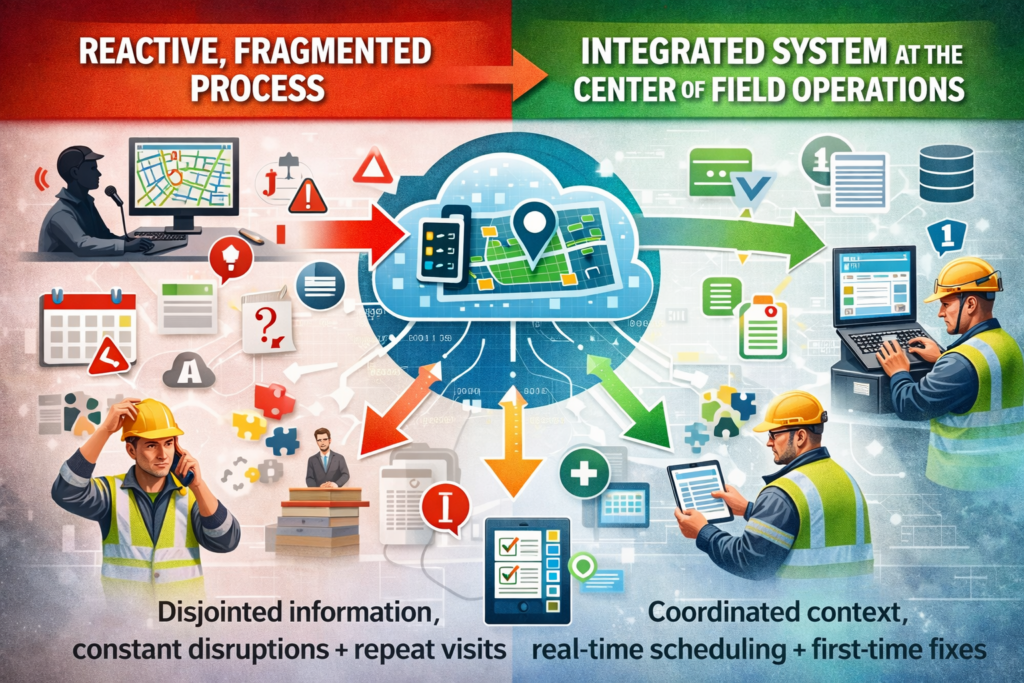
When field operations are backed by technology that actually fits the work, everything shifts.
IFS Field Service Management pulls planning, dispatch, mobility, and execution into one platform — built specifically for complex, asset-heavy industries like utilities. Instead of forcing field teams to work around system limitations, it gives them a coordinated, intelligent environment that adapts as the day unfolds.
Smart Planning & Scheduling
With Planning & Scheduling Optimization (PSO) built in, work gets assigned based on what’s actually true — not what someone assumed at 6 AM:
- Skills and certifications checked before anyone gets dispatched
- Asset history and safety requirements pulled up automatically
- Location and travel time factored in across the whole workforce
- Priorities sequenced around SLA commitments and real business impact
- Parts availability confirmed before a technician is even en route
Industrial AI That Actually Helps
IFS.ai is constantly working through real-time and historical data to help teams see what’s coming, make better calls, and adjust schedules on the fly throughout the day. And when conditions change — which, in utility operations, is basically always — the system adjusts with them instead of falling over.
First-Time Fixes, Built Into the Process
Field crews arrive with the full picture: context, knowledge, tools — everything in one place. When a job turns out to be more complex than expected, knowledge bases and remote expert support are right there. No phone trees. No driving back to the office.
And the admin work — time capture, parts usage, all of it — gets handled as part of the natural flow of work. Not dumped on a tired technician at the end of a 10-hour day.
What This Actually Means for Utilities
The right technology pays off in three areas that matter most:
1. Get More from the Workforce You Have
Electrification is driving demand up. Experienced field workers are getting harder to replace. Cutting travel time, eliminating repeat visits, and reducing manual coordination creates real capacity — without needing to hire proportionally more people.
2. Respond Faster When Things Go Wrong
Severe weather and aging infrastructure mean more unplanned work, and more complex work. When your planning and scheduling can adapt in real time, you restore service faster and keep customer impact to a minimum.
3. Bring Costs Under Control
Sloppy execution is expensive — longer outages, wasted trips, regulatory headaches. Consistent execution, better first-time fix rates, and hitting your SLAs keeps costs predictable and protects the trust your customers and regulators expect.
Six Questions Worth Asking Right Now
Want to know how well your current setup is actually supporting your field teams? Be honest with these:
- How many systems does a technician juggle during a typical service call? Do they have one mobile view with everything they need — or are they flipping between apps?
- When priorities shift mid-day, can your schedule adapt dynamically? Or does one disruption knock the whole week sideways?
- Are skills and certifications verified before someone gets dispatched? Or do you only find out there’s a gap when they’re already on site?
- When a job gets complicated, can your technician find parts, call in backup, or reach an expert remotely? Or does the job just get rescheduled?
- Are admin tasks — parts replenishment, paperwork, time tracking — handled within the workflow? Or are they piled on at the end of an already long day?
- Do you actually know what disconnected execution is costing you? The repeat visits, the wasted drive time, the missed SLAs, the technician burnout?
If most of those answers make you wince a little — that’s not a hiring problem. That’s a signal it’s time to rethink the platform your field work runs on.
Set Your Teams Up to Succeed
You can’t control demand spikes or the next big storm. But you absolutely can control how well your workforce is supported when those moments hit.
Modern utility operations need the visibility, intelligence, and coordination to handle change as it happens — so your field teams spend their time delivering reliable service, not working around the limitations of their tools.
The technology is here. The question is whether you’re ready to put it to work.
Want to see what this looks like for your utility? JumpModel works with utilities to design and implement IFS Field Service Management solutions built around the real-world challenges of energy, water, and gas networks. Let’s talk about where the biggest opportunities are in your field operations.